
Something is shifting in the world of electronics manufacturing. Quietly, and with increasing momentum, a generation of European researchers, engineers, and companies is dismantling assumptions the industry has held for decades, assumptions about how circuits are made, what materials they require, how they are powered, and what happens to them at end of life.
The ENLIGHTENED project sits at the centre of this shift. A Horizon Europe research initiative coordinated by Epishine and bringing together twelve partners from seven countries, ENLIGHTENED is working toward a single, ambitious goal: developing the standard for how light-powered, flexible hybrid electronics are built, affordably, sustainably, and at scale.
This is not a story about one technology or one company. It is a story about what becomes possible when the right expertise is assembled across an entire value chain, from the molecular design of new materials to the shelves of a retail store.
Traditional electronics manufacturing carries a heavy environmental cost. Printed circuit boards rely on copper, solder, and hazardous chemicals. Production is energy-intensive, and end-of-life management remains deeply inadequate. According to the United Nations, global e-waste reached a record 62 million tonnes in 2022, growing five times faster than formal recycling capacity.
The Internet of Things is accelerating the urgency. IoT Analytics (2025) tracks 18.5 billion connected devices in 2024, projected to reach 39 billion by 2030, sensors, tags, displays, and smart devices embedded into buildings, supply chains, retail shelves, and consumer products. Each needs to be manufactured. Each needs to be powered. Each will eventually need to be disposed of or recycled.
Powering this many devices through disposable primary batteries is not viable, environmentally, economically, or logistically. The question is what replaces them, and who builds that replacement at scale.
The Flexible Hybrid Electronics market is projected to grow from USD 1.8 billion in 2025 to USD 7.6 billion by 2035 at a CAGR of 15.5%, according to SNS Insider (January 2026). Europe holds world-class capabilities across every layer of this value chain, but translating research excellence into industrial leadership requires sustained, coordinated investment.
ENLIGHTENED is precisely that kind of coordinated effort. Its LCA-driven approach means environmental performance is built into the development process from day one, measuring and actively reducing the lifecycle footprint of the technology in parallel with its technical development. This is not a sustainability add-on. It is a design constraint.
For policy makers shaping EU industrial strategy, that combination, a European supply chain, multi-country collaboration, sustainable manufacturing methodology, and end-user validation, aligns directly with the European Green Deal and the broader digital and green transition agenda.
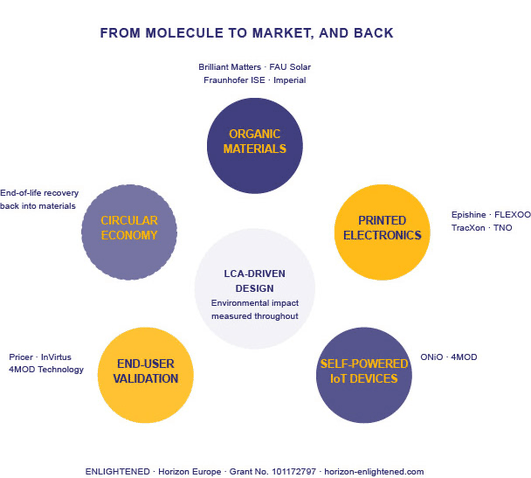
Figure 2, from molecule to market and back: the ENLIGHTENED circular value chain
The ENLIGHTENED project, described in full at horizon-enlightened.com, focuses on combining photovoltaic cells with flexible printed circuit boards, energy storage, and electronic components in an affordable, automated, and scalable manner. The result is a new class of light-powered, flexible hybrid electronics that can replace battery-dependent devices across IoT, retail, property technology, and consumer electronics.
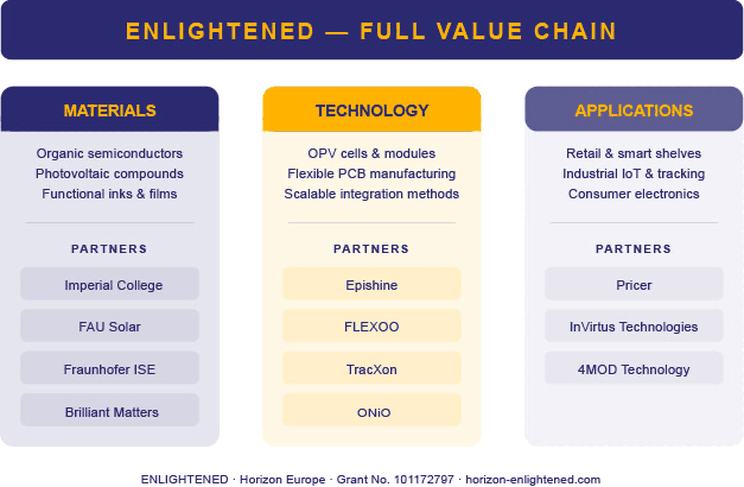
The project addresses this challenge across three interconnected dimensions:
Developing the organic semiconductor materials and photovoltaic layers that make light-powered flexible electronics possible, with higher performance, greater reliability, and processing methods compatible with large-scale manufacturing.
Building new scalable methods for integrating photovoltaic modules with flexible circuit boards, energy storage, and electronic components, the step where laboratory materials become manufacturable products.
Deploying and testing demonstrators in real end-user environments, retail, industrial IoT, connected devices, to validate that the technology performs under the conditions the market actually requires.
What makes ENLIGHTENED distinctive is the deliberate breadth of its consortium. Rather than advancing a single technology, the project has assembled complementary expertise across every layer of the flexible hybrid electronics stack, from fundamental materials research to commercial end-user deployment.
The partners span organic semiconductor development, printed electronics manufacturing, photovoltaic device engineering, applied research, self-powered microelectronics, industrial IoT, connected device design, and retail-scale deployment. Together they cover, from Brilliant Matters' organic semiconductor chemistry to Pricer's global retail infrastructure, from Fraunhofer ISE's solar research depth to TracXon's cradle-to-cradle printed circuit manufacturing, everything needed to take the technology from molecule to market.
In alphabetical order, the ENLIGHTENED consortium:
– Epishine
– FLEXOO
– ONiO
– Pricer
– TNO
– TracXon
The project runs from September 2024 to August 2027, coordinated by Epishine and funded under the EU Horizon Europe programme (Grant Agreement No. 101172797).

Funded by the European Union. Views and opinions expressed are those of the author(s) only and do not necessarily reflect those of the European Union or the European Climate, Infrastructure and Environment Executive Agency. Neither the European Union nor the granting authority can be held responsible for them.